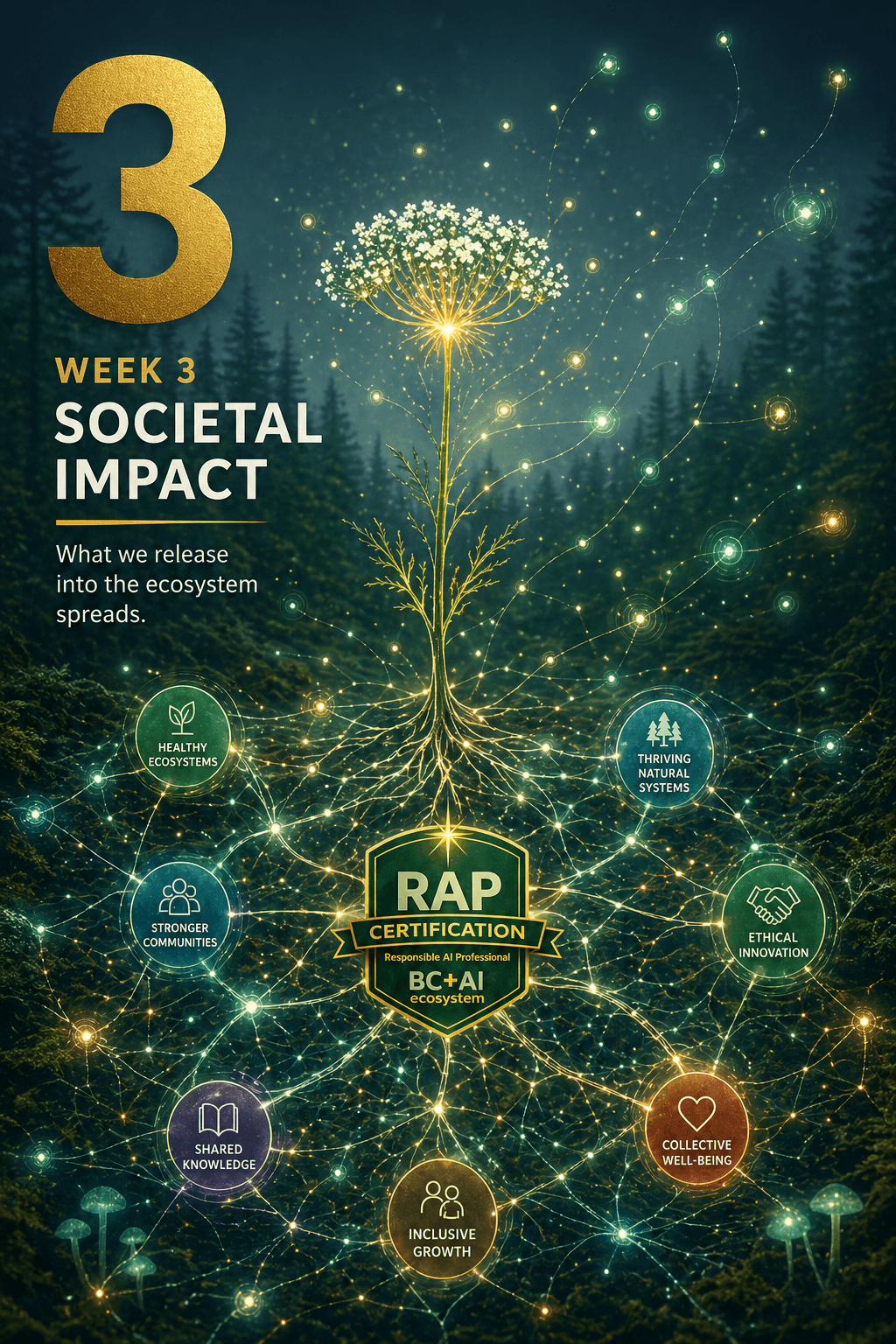
The argument
Most deployment failures are predictable. We work through 33 documented cases, build a deployment readiness checklist your team can actually use, and confront the carbon math: at scale, model choice is an environmental decision. Right-size or be ready to defend that you didn't.
What you build with
6 interactive widgets

Sample from the live course
Deployment Checker
- 01Deployment Checker
- 02Labor Spectrum
- 03Environmental Check
- 04Carbon Calculator (26-model dataset)
- 05Failure Catalog (33 cases)
- 06Stakeholder Mapper
Deployment, Labor & Environment
Societal Impact.

The artifact
Deployment Readiness Report
A go/no-go report for a specific AI deployment — stakeholders mapped, labor effects named, carbon footprint quantified, and a list of failures you've explicitly designed against.
Quiz preview
25 questions. 80% to pass.
Three sample questions in the same style. The live course has more — and they're harder than they look.
Question 01
A team defaults to GPT-4 for sentiment classification on 50k weekly tickets. The Carbon Calculator suggests Llama 3 8B at 1/30 the kWh. What's the right-sized choice?
- a)Stay on GPT-4 for accuracy
- b)Switch to Llama 3 8B if eval passes
- c)Move to GPT-3.5 as a compromise
- d)Add a cache layer
Question 02
Of 33 documented deployment failures in the Failure Catalog, the single most common root cause was:
- a)Model accuracy below spec
- b)Inadequate stakeholder consultation
- c)Hardware constraints
- d)Regulatory non-compliance
Question 03
On the Labor Spectrum, a system that handles triage and escalates edge cases to a human reviewer sits closest to:
- a)Displacement
- b)Augmentation
- c)Surveillance
- d)Full automation