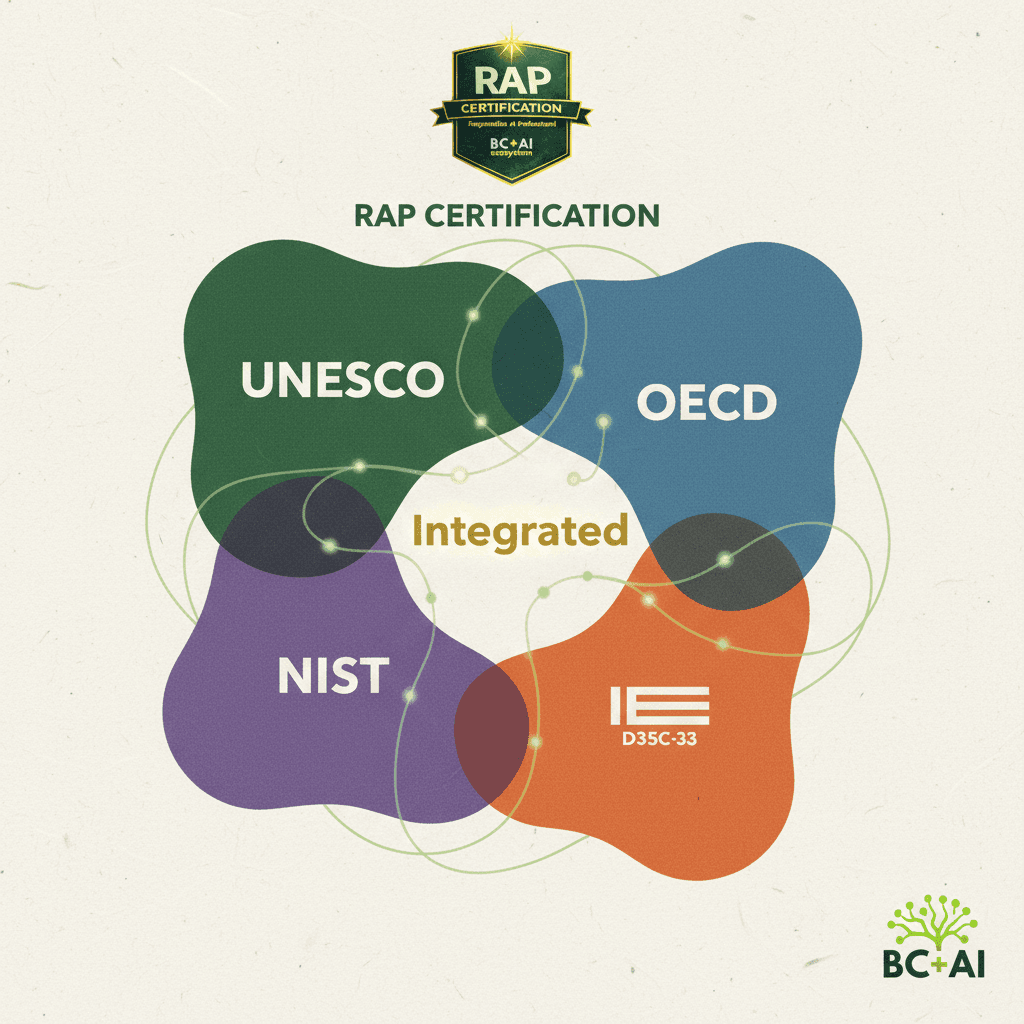
Argument over content
We don’t teach you facts about AI. We teach you the arguments that should change your behavior.
Methodology
Four pedagogical principles, eight governance frameworks, one Indigenous knowledge approach.
Pedagogical Principles
We don’t teach you facts about AI. We teach you the arguments that should change your behavior.
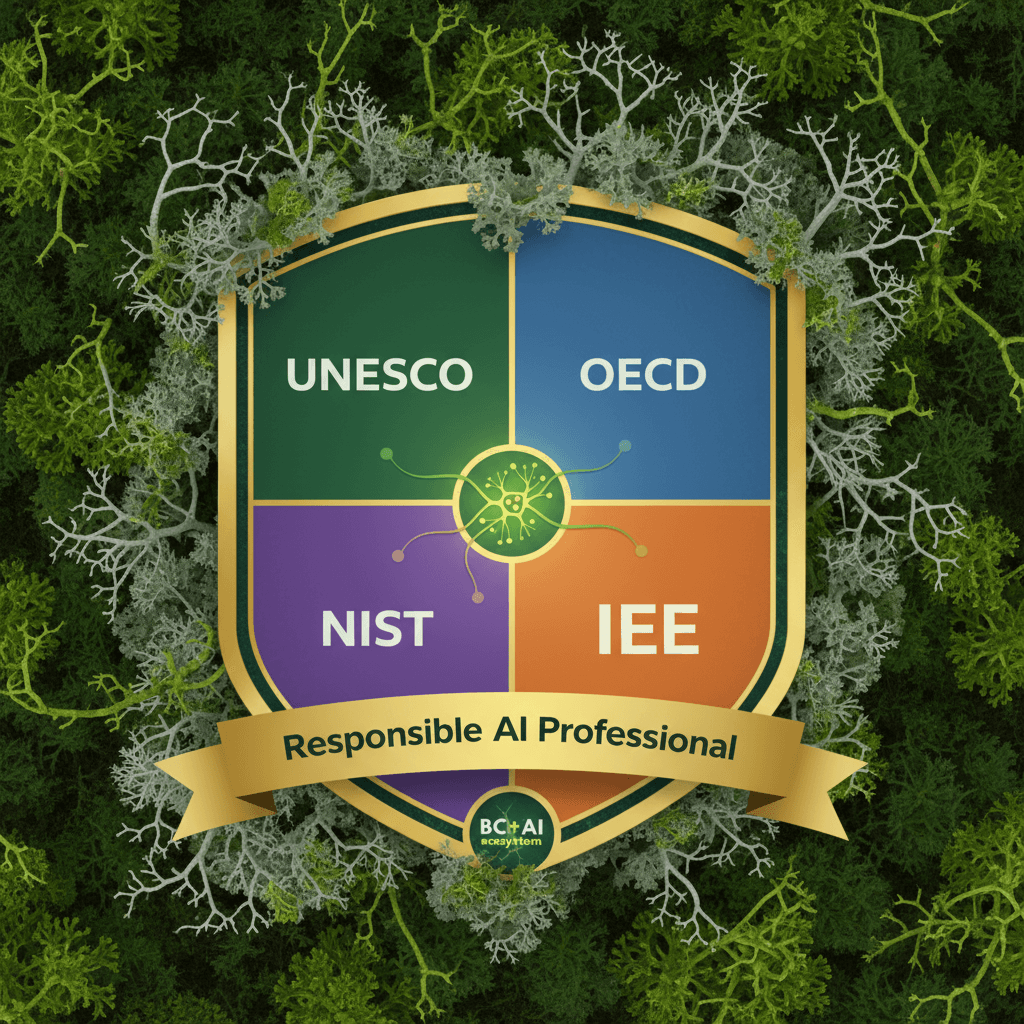
Heuristics break under pressure. Frameworks compose. UNESCO, OECD, NIST, IEEE, CARE, OCAP — you’ll know which one applies before you reach for a checklist.
Every module produces a PDF your organization can act on. Personal AI Inventory. Ethics Assessment. Deployment Readiness Report. Capstone Governance Doc.
Asynchronous video is a research tool, not a learning tool. The cohort, the live sessions, and the seat cap are what change you.
Governance Frameworks
You leave RAP knowing which framework applies before you reach for a checklist. Global, national, sectoral, Indigenous — every cohort works through all eight.
Framework
Global ethical principles for AI, signed by 193 member states (2021).
Framework
Five principles + national policy framework guidance, broadly adopted.
Framework
US risk management framework with measurable functions.
Framework
Standards body view of AI ethics; focus on system-level engineering practice.
Framework
EU general data protection regulation; the consent + portability baseline.
Framework
California privacy law; the US-domestic GDPR analog.
Framework
Collective benefit, Authority to control, Responsibility, Ethics — Indigenous data sovereignty principles.
Framework
Ownership, Control, Access, Possession — First Nations data governance framework.

Indigenous Knowledge
RAP is built and taught on the unceded, ancestral, and traditional territories of the xʷməθkʷəy̓əm (Musqueam), Sḵwx̱wú7mesh (Squamish), and səlilwətaɬ (Tsleil-Waututh) Nations. The land is not a backdrop; it is a relationship, and that relationship shapes how we teach governance.
Module 2 (Privacy + Data Governance) and Module 4 (Indigenous Knowledge) place CARE and OCAP alongside GDPR and CCPA — not as optional add-ons, but as foundational. Collective benefit and community authority are governance primitives, not afterthoughts to a Western privacy regime.
AI systems built without Indigenous data sovereignty principles inherit a centuries-long extractive pattern. The cohort works through what it means to refuse that inheritance — in training data, in model deployment, in organizational policy, and in the artifacts you ship.