The argument
How LLMs actually work — tokenization, attention, next-token prediction — and why every confident-sounding output deserves verification. We map the four governance frameworks (UNESCO, OECD, NIST, IEEE) so you know which one will be cited at you in which meeting.
What you build with
4 interactive widgets
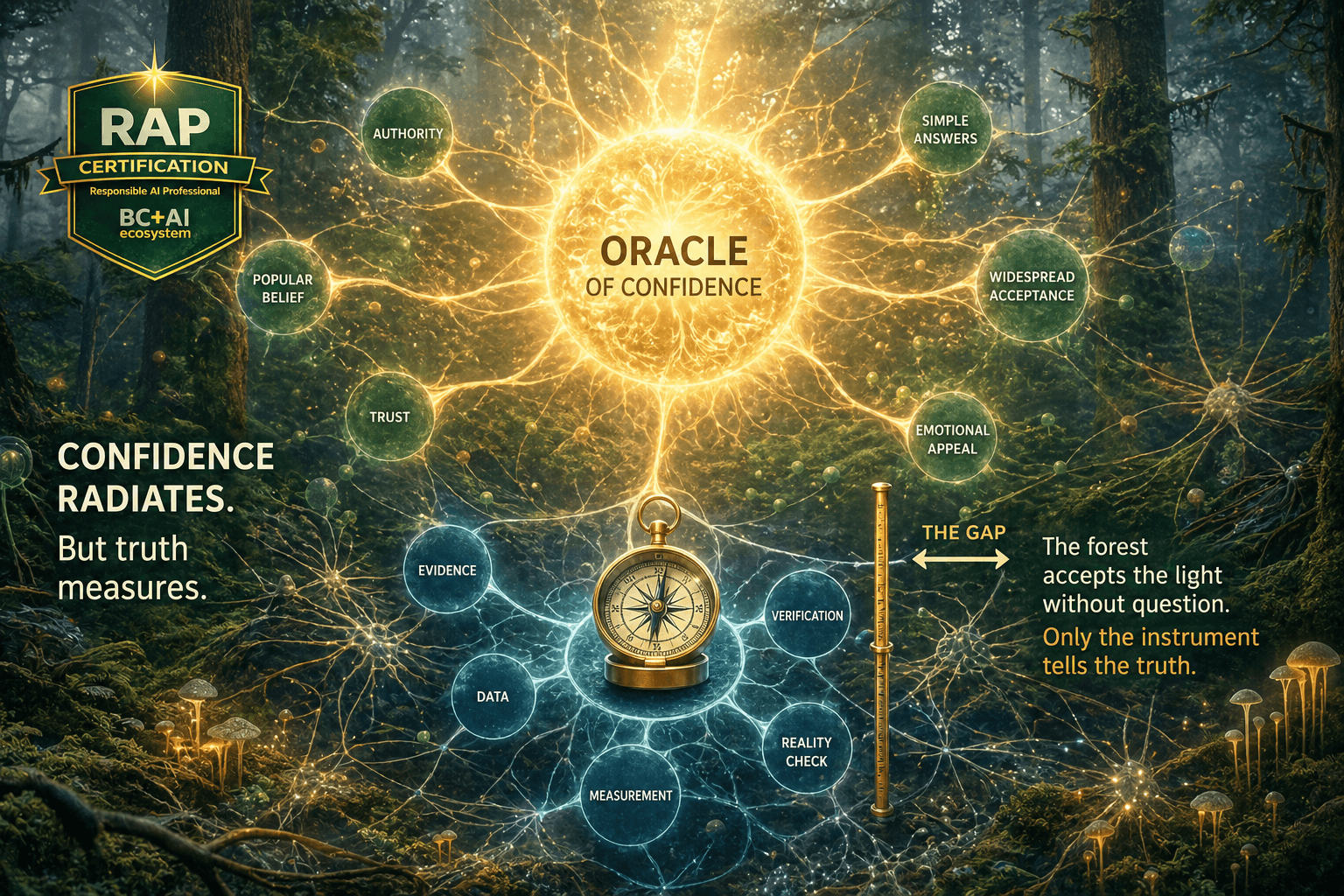
Sample from the live course
Risk Matrix
- 01Risk Matrix
- 02Hallucination Spotter
- 03Citation Verifier
- 04Prompt Lab
Understanding AI and Its Limits
Foundations.
The artifact
Personal AI Inventory
A working document of every AI system touching your work — with accuracy risks, governance gaps, and a verification protocol your team can adopt on Monday.
Quiz preview
20 questions. 80% to pass.
Three sample questions in the same style. The live course has more — and they're harder than they look.
Question 01
An LLM confidently fabricates a court citation. Which framework principle is most directly relevant to your response?
- a)UNESCO transparency
- b)NIST traceability
- c)OECD accountability
- d)IEEE prioritization of human well-being
Question 02
Next-token prediction explains why an LLM can sound fluent and still be wrong. The most precise term for this failure mode is:
- a)Bias amplification
- b)Confabulation
- c)Mode collapse
- d)Reward hacking
Question 03
Your CFO wants a single risk score for a customer-facing AI chatbot. The Risk Matrix asks you to combine which two axes?
- a)Cost and latency
- b)Likelihood of failure and severity of impact
- c)Model size and training cost
- d)Vendor reputation and contract length